
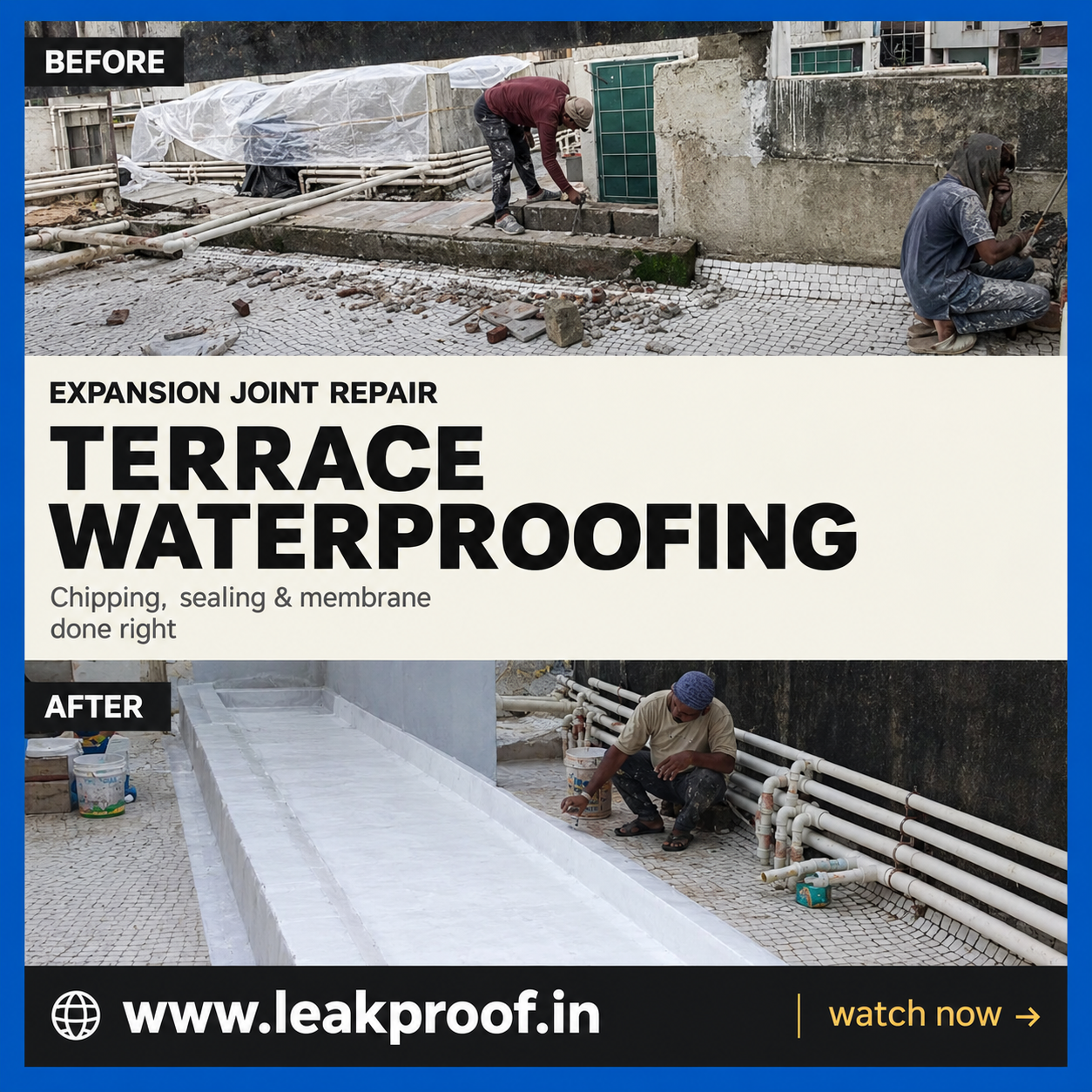
Expansion Joints
Modern buildings are becoming taller, larger and more complex, with multiple basements, large podiums, terraces, parking areas and integrated services. As building structures become more complex, the number of joints and junctions also increases.
Expansion joints, construction joints and service penetrations are essential parts of a building, but they can also become vulnerable points for water ingress and leakage if they are not properly waterproofed and protected.
Why Are Building Joints Vulnerable to Water Leakage?
Building joints experience movement due to temperature changes, structural movement and vibration. Waterproofing materials and sealants around these joints must therefore accommodate movement while maintaining water-tightness.
External exposure can further increase the risk. In areas with heavy rainfall and humidity, joints on terraces, podiums, decks and other exposed surfaces may remain in contact with water for extended periods.
Where pedestrian or vehicular traffic is present, mechanical stress and abrasion can also affect the waterproofing system.
This makes expansion joint waterproofing and construction joint waterproofing an important part of building maintenance.
Common Types of Joints Requiring Waterproofing
Different types of joints require different waterproofing approaches depending on their location, movement and exposure.
Expansion Joints:
Designed to accommodate movement between different sections of a building. The waterproofing system must remain flexible enough to accommodate this movement.
Construction Joints:
Created when concrete construction takes place in stages. If not properly treated, these joints can become pathways for water, particularly in basements, podiums and retaining structures.
Pipe & Service Penetrations:
Pipes, cables and other services passing through walls and slabs can create openings where water may enter. These interfaces need proper sealing and waterproofing.
Waterproofing Solutions for Building Joints
The appropriate treatment depends on the type of joint, its condition, expected movement and water exposure. Common solutions include:
- Flexible Sealants: Used to seal joints while allowing the required movement.
- Liquid-Applied Waterproofing: Provides a continuous waterproofing layer around joints and complex junctions.
- Membrane Systems: Suitable for horizontal and vertical surfaces where continuity of waterproofing is required.
- PU Injection Grouting: Used where water is already entering through cracks, joints or concealed pathways. PU resin can be injected into selected areas to help seal water pathways.
In many situations, a combination of these methods may be required rather than a single waterproofing treatment.
Protecting Waterproofed Joints
Waterproofing a joint is only part of the solution. Once treated, the joint may be exposed to construction activity, foot traffic, vehicles, weather, UV radiation and mechanical abrasion.
Providing an appropriate protective layer or protective detail can help preserve the waterproofing system. However, protection over an expansion joint must not restrict the movement for which the joint was designed.
Regular inspection is also important, particularly for exposed joints, as deterioration of sealants or waterproofing materials can eventually lead to water leakage.
Expansion Joint Waterproofing in Mumbai
In Mumbai and the surrounding Mumbai Metropolitan Region, buildings are exposed to heavy monsoon rainfall, high humidity and seasonal weather variations.
Terraces, podiums, basements, parking areas and other large surfaces can therefore require particular attention to expansion joint leakage and construction joint leakage.
Water entering through a joint may travel through concealed pathways and appear at a completely different location. Treating only the visible damp patch may therefore not permanently solve the problem.
A proper water leakage detection and waterproofing assessment can help identify the source of water ingress, understand the leakage path and determine the appropriate treatment.
A Practical Approach to Joint Waterproofing
A systematic approach can include:
Inspection → Leakage Source Identification → Joint Assessment → Surface Preparation → Joint Treatment → Waterproofing → Protection → Testing → Maintenance
The right solution depends on the joint type, movement requirements, water exposure, substrate condition and accessibility.
Watch Our Expansion Joint Waterproofing Video
Leakproofanalytix has also created a practical video demonstrating the treatment and protection of expansion joints at the terrace to waterproof the terrace.
https://www.youtube.com/shorts/XEc8B22LNj0
The video provides a practical visual understanding of how expansion joints can be treated as part of an overall building waterproofing system.
Conclusion
Expansion joints, construction joints and service penetrations are essential components of modern buildings, but they can become vulnerable points for water leakage when they are not properly detailed, waterproofed and protected.
A durable solution should address not only the visible leakage but also the source of water ingress, joint movement and surrounding construction.
The appropriate combination of flexible sealants, waterproofing membranes, protective detailing and PU injection grouting, where required, can help protect these vulnerable areas.
For buildings in Mumbai, Thane and the surrounding region, timely inspection and maintenance of waterproofed joints can help prevent minor defects from developing into major leakage problems.
Leakproof.in provides waterproofing and leakage solutions for residential, commercial and industrial structures, with solutions selected according to the condition and requirements of the building.